
In brief
Assess residence separately for each Indian tax year. Start with the day-count tests, apply the exception for your circumstances, then check deemed residence and RNOR. The rules and day counter are below.
Source for this answer: Income Tax Department: Income-tax Act, 2025, section 6 (amended by Finance Act 2026)
What can change the answer: A UAE visa or a single day count is not a complete residency assessment. Confirm the law and relevant tax period with a qualified adviser.
What is RNOR status for an NRI returning to India?
RNOR means resident but not ordinarily resident. First establish that you are resident for the particular Indian tax year; then test RNOR. It is not a fixed tax holiday granted to everyone who returns.
| Check | What to establish |
|---|---|
| Check residence first | Apply the year’s residence rules and relevant exceptions. A return to settle is not automatically a visit. |
| Check the history tests | RNOR can follow if you were non-resident in nine of the previous ten years, or spent no more than 729 days in India in the previous seven years. Additional special categories exist. |
| Keep the conclusions separate | Income-tax status, bank status under FEMA and treaty entitlement answer different questions. |
Worked preparation example
Fictional example: a person who is resident this year and was non-resident in nine of the preceding ten years satisfies that RNOR history limb. The number of future RNOR years cannot be inferred without updating the history each year.
Supporting official material: Income Tax Department: Income-tax Act, 2025, section 6 (amended by Finance Act 2026) · Income Tax Department: Non-resident tax transition FAQs: NRE interest.
This section’s supporting sources were checked 2026-10-25. Illustrations and document checks are editorial preparation guidance, not an individual eligibility or title determination. No professional review is claimed.
Which residency rule applies?
These section references apply to tax years beginning on or after 1 April 2026 under the Income-tax Act, 2025, as amended by Finance Act 2026. Earlier years use the 1961 Act. Look-back periods still include relevant earlier years.
| Your situation | Rule and conditions |
|---|---|
| General individual test | 182 days or more in India during the year; OR 60 days or more this year AND 365 days or more across the preceding four years. Check the departure and visitor exceptions below before using the 60-day test. Act §6(2) |
| Indian citizen leaving for overseas employment or as crew of an Indian ship | The 60 + 365 test does not apply in that departure year. The 182-day test remains. This exception is for Indian citizens. Check deemed residence separately. Crew cases require the separately prescribed day-count method. Act §6(3), 6(6) |
| Indian citizen or person of Indian origin living abroad and visiting India; relevant income ₹15 lakh or less | The 60 + 365 test does not apply. The 182-day test remains. The stay must qualify as a visit. Do not automatically apply the visitor exception to a return to settle. Act §6(4) |
| Same visitor, with relevant income above ₹15 lakh | 182 days or more; OR 120 days or more this year AND 365 days or more across the preceding four years. 120 days alone is insufficient. Exactly ₹15 lakh does not trigger this provision. If resident with a stay of 120–181 days, the special RNOR rule applies. Act §6(5), 6(13)(c) |
| Indian citizen not already resident under the preceding tests | Deemed resident if relevant income exceeds ₹15 lakh AND the person is not liable to tax elsewhere by reason of domicile, residence or similar criteria. No minimum India stay applies. Not paying tax is not, by itself, proof of not being liable to tax. Deemed residents are RNOR. Act §6(7)–(8), 6(13)(d) |
What counts towards ₹15 lakh? Relevant income here means total income excluding “income from foreign sources” as defined in section 6(14). Foreign-source income excludes income from an India-controlled business or India-established profession, and income deemed to arise in India. Do not substitute gross worldwide earnings or the amount remitted to India.
Then check RNOR
After establishing residence, check resident but not ordinarily resident (RNOR) status: non-resident in at least nine of the preceding ten years, OR 729 days or less in India in the preceding seven years. RNOR also covers qualifying high-income visitors resident under the 120-day rule with a stay of 120–181 days, and citizens deemed resident under section 6(7).
Income-tax Act, 2025 · §6(13)–(14) · Rules checked .
The table is general information. Confirm the applicable facts and legal day-count method with your adviser. Income-tax residence, FEMA residence and treaty entitlement are separate assessments.
Count your days in India
Use your travel record to prepare the day-count part of the assessment.
Add your first trip to see the count.
Method: inclusive calendar days, restricted to 1 April–31 March, with overlaps merged. This is a preparation count, not a legal residency determination. Crew and other special cases require a separate counting method. Travel inputs remain in page memory and disappear on reload.
Keep citizenship, tax residence and FEMA residence separate
These labels answer different questions. Your nationality or OCI card does not alone determine the year’s Indian tax treatment. Establish the relevant year, travel history, income sources and exceptions.
Your next steps
0 of 5 steps complete · Next: Choose the year
Choose the year
Next stepKeep tax years separate. The Income-tax Act, 2025 applies to tax years beginning on or after 1 April 2026; earlier years use the 1961 Act.
Reconstruct your travel
Use passport stamps, immigration records and tickets. The day counter here helps organise calendar days; it does not determine residency.
Identify the purpose of the stay
A visit, leaving for overseas employment and returning to settle may require different assessments.
Check the exceptions
Ask about Indian citizenship or PIO status, income other than foreign-source income and liability to tax elsewhere.
Check RNOR and treaty issues separately
Prior-year history and treaty residence can matter even after the first resident/non-resident test.
Suggested preparation sequence. Your authority may require a different order. Progress stays on this device.
What to have ready
0 of 4 preparedKeep documents in your own secure records. Tick what you have; nothing is uploaded.
Give your adviser a complete travel record
Build the timeline
List entries and exits with passport and travel evidence for the relevant period and any earlier years requested by your adviser. Flag missing or conflicting dates.
Separate the different questions
Ask the adviser to assess income-tax residence, the bank to address FEMA account status, and a treaty specialist to assess any treaty claim. Do not use a visa or one day-count result as a universal answer.
Record the conclusion
Ask for the applicable tax period, provisions, assumptions and unresolved facts in writing. Revisit the assessment if travel or employment plans change.
Practical checklist added 2026-09-23. This is an editorial addition, not a fresh review of every legal statement in the guide.
Model the decision with your own figures
Prepare the dates, currencies, costs and amounts you know. Keep tax eligibility, provider access and uncertain assumptions on your adviser’s question list. The calculators show those assumptions explicitly.
For a return to India, add education, parents’ support, healthcare, partner income and locked funds to the household timeline. Bring supporting-tool figures into it only after reviewing timing, currency and overlap.
Three questions to keep separate
| Question | Prepare | Confirm with |
|---|---|---|
| Which account designation applies? | Your move, employment and intended-stay details; each account and deposit. | Your bank’s NRI desk. |
| What is my Indian tax residence? | Travel history, relevant income and earlier-year records. | A CA experienced in non-resident taxation. |
| Can I claim a treaty benefit? | The specific income, period, certificate and treaty conditions. | An adviser familiar with both countries and the applicable treaty. |
Illustrative situation
You spend fewer than 182 days in India. Do not stop there: ask whether another test or exception applies to your citizenship, income and circumstances.
A fictional preparation example, not a determination of eligibility, tax or legal rights.
Recognise the official form
Preview before you visit the official portal. Do not enter or upload personal information here.
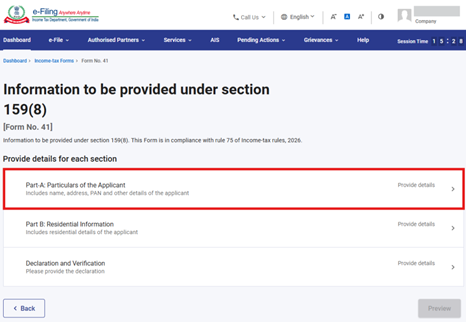 Enlarge preview ↗
Official online screen example
Form 41 · Treaty information
The department’s manual shows the online form for prescribed information supporting a non-resident’s treaty-relief claim under section 159 and Rule 75.
What you will see on the form
Part A: applicant particulars · Part B: residential information · Declaration and verification
This is a screenshot from the official manual, not a blank paper form or proof of eligibility. Confirm the tax year and applicable Act with your CA. Filing is online through the official e-Filing portal.
Income Tax Department · Source checked 5 September 2026
Questions to take to an adviser
- Which exact residency provision applies to this year and why?
- Do the 120-day or deemed-resident provisions apply?
- If resident, am I RNOR, and does a treaty change the outcome?
Who can help
A CA experienced in cross-border individual taxation.
Check an adviser before paying or signingClaims, exceptions and the supporting evidence
Check what you may have heard
Source review: 5 September 2026 · Rules may change after this date.
Form 41 is used to furnish treaty information.
The Income Tax Department publishes a current Form 41 manual under the 2025 Act, Section 159 and Rule 75. Select the relevant tax year. Older Form 10F references concern the earlier framework; neither a form nor a TRC alone guarantees exemption.
Sources & review limits
Published by NRIdisha. Prepared with AI assistance. No individual author or qualified professional reviewer is credited for this guide.
Residency rule table checked against section 6 of the current Act on 21 October 2026. Other supporting material retains its stated check date.
Official sources support the statements they address. They do not certify this guide or your eligibility. Open the source and check current amendments before acting.
Income Tax Department (opens in a new tab) · Reserve Bank of India (opens in a new tab) · National Portal of India (opens in a new tab)
Individual residence, visitor and departure exceptions, deemed residence, RNOR and the foreign-income definition.
Residency exceptions, RNOR and the transition between the 1961 and 2025 Acts.
Keep this page’s title, the exact statement and the official source. Email them to support@nridisha.com. Do not include personal documents.